Blog

  • How to Handle Aggressive Customers in Customer Service: Lessons from the Front Desk Frontline

    How to handle aggressive customers in customer service is not something you master in a training room. It’s learned through lived experience—those moments when the atmosphere turns tense and you must choose professionalism over pride.

    A Real Encounter: When a Customer Stormed In

    One Friday at 2:15 p.m., a man stormed past my desk without a word. He walked straight into the back office like he owned the place.

    My colleague looked at me, puzzled.
    “Where is he going? There’s no one back there.”
    I was helping another client, so I calmly said, “Let him go—he’ll be back.”

    Sure enough, he returned, clearly annoyed, and rudely interrupted my conversation.
    “Isn’t there someone back there?”
    I paused. “Did you find anyone?”
    No apology. Just a demand to be served.

    But I didn’t budge. I continued with the first client. Eventually, he realized he was out of line and sat down to wait.

    Moments like this taught me what books don’t: how to handle aggressive customers in customer service with calm, clarity, and control.


    Why Learning How to Handle Aggressive Customers in Customer Service Matters

    Whether you’re a receptionist, security guard, cashier, or call center rep, you’ve likely encountered anger, entitlement, or outright hostility. These moments test your patience, your training—and sometimes your safety.

    Knowing how to handle aggressive customers in customer service isn’t just about company policy. It’s about:

    • Protecting your peace
    • Maintaining dignity
    • Safeguarding workplace morale

    Real-Life Lessons from the Frontline

    Not all aggression is verbal. One of my worst experiences?

    A customer slapped me across the face.

    Why? I told her to check in at reception before seeing the doctor. She had barged in, skipping the line. Later, I found out she was the landlord of the doctor I worked for.

    He tried to calm things down, but the power dynamics were messy. I stood there—shaken, embarrassed, and aware that my safety wasn’t guaranteed.


    How to Handle Aggressive Customers in Customer Service: Foundational Skills

    1. Stay Calm and Composed

    Aggression feeds off reaction. Staying still, breathing deeply, and using a steady voice can de-escalate tension faster than shouting ever could.

    Affiliate link:
    Noise-canceling earbuds – perfect for decompressing after a long shift »

    2. Maintain Clear Boundaries

    Be firm yet respectful. For example:
    Please allow me to finish with the current client.
    This sets a tone of calm authority, and lets others know you’re in control.


    Tools That Help You Handle Aggressive Customers in Customer Service

    Use Scripts to Stay Grounded

    Having a few key phrases ready helps during stressful moments:

    • “I understand you’re upset. Let me assist you step by step.”
    • “I hear your concern. Let me help resolve it.”

    Affiliate link:
    Soft skills training for customer service »

    Keep Records

    If something crosses the line, document it. A short note can protect your job and help in escalating persistent issues.


    When Aggression Becomes a Safety Issue

    Know When to Step Away

    If someone becomes physically threatening, remove yourself immediately. No service is worth risking your life.

    Call for Backup

    Alert a supervisor or security. Don’t try to manage danger alone.

    Internal link:
    Blending Technology and Human Care » — Tools like panic buttons, intercoms, and security systems make a real difference.

    Affiliate link:
    Wireless panic button alarm system »


    Understanding the Psychology Behind Aggression

    Often, customers lash out due to fear, pain, or stress—especially in places like hospitals, insurance offices, or financial institutions.

    Use Empathy Without Being Exploited

    You can say:
    I see you’re frustrated. I’ll do what I can within our process.
    It shows empathy without enabling abuse.

    Don’t Take It Personally

    It’s rarely about you. Often, aggression reflects unresolved personal issues in the customer’s life.


    How to Handle Aggressive Customers in Customer Service Professionally

    Use Professional Language

    Avoid sarcasm or defensiveness. Be neutral and composed.

    Avoid Power Struggles

    Don’t get dragged into a shouting match. Instead, say:
    I’d like to help, but we’ll need to follow the process.

    Outbound link:
    OSHA: Workplace Violence Prevention Guidelines »


    Smaller Aggressions Count, Too

    Not all aggression is loud. Examples include:

    • Interrupting others
    • Ignoring instructions
    • Playing loud videos in waiting areas

    These behaviors erode morale over time.

    Internal link:
    Customer Service in Microfinance » — A glimpse into daily disrespect and survival in high-pressure customer care.

    Affiliate link:
    Anti-fatigue standing mat – helpful for long desk hours »


    How to Handle Aggressive Customers in Customer Service Without Losing Yourself

    Debrief and Decompress

    Talk to someone. Journal. Go for a walk. Stress builds up silently—let it out.

    Affiliate link:
    Guided journal for professionals »

    Build a Support System

    Find people who understand the emotional toll—friends, mentors, or online communities.


    Self-Protection Isn’t Selfish: Sobering Examples

    Even the most secure environments are vulnerable.

    🕒 United States Case

    On September 19, 2024, Judge Kevin R. Mullins was shot and killed inside his chambers in Whitesburg, Kentucky. The assailant was Sheriff Shawn “Mickey” Stines.

    🕒 Kenyan Case

    On June 15, 2024, Makadara Magistrate Monica Kivuti died after being shot in open court by a police officer upset over a bail ruling involving his wife.

    Read the full story on
    The Star »

    These tragic cases remind us: no job is completely safe. Customer service professionals must remain alert, set boundaries, and prioritize self-preservation.


    Final Thoughts: How to Handle Aggressive Customers in Customer Service with Grace and Strength

    Not every day will be easy. You’ll meet hostility, arrogance, or worse. But each challenge gives you a chance to respond with composure, strength, and dignity.

    How to handle aggressive customers in customer service is not a skill you check off—it’s a lifelong lesson that strengthens your professional backbone.


    What’s Your Experience?

    Have you faced a tough customer?
    💬 Share your story in the comments or email me at lobbyreflections@gmail.com

  • The Power of Feedback: Why Your Voice Matters in Healthcare and Beyond

    A Lesson Learned the Hard Way

    One of my personal mantras is: “Negative feedback is far better than no feedback at all.” Feedback, to me, is a compass—it points us toward growth, accountability, and improvement.

    Years ago, I took my then seven-year-old son to a private hospital. He needed an injection and, like most kids, was frightened. What shocked me was not his fear, but the rough way the nurse handled the procedure. She jabbed the needle so forcefully, I feared it might break inside him. I was horrified.

    Still, I said nothing.

    I calmed my son and promised him the next time would be better. But deep inside, I knew I had let something slide that shouldn’t have.


    Why Didn’t I Speak Up?

    It was a private hospital, and I expected better care. But even there, I stayed silent.

    Unfortunately, this wasn’t my only unpleasant encounter in a medical facility. Over the years, I’ve had countless negative patient experiences—from indifferent nurses to receptionists who couldn’t be bothered to look up when you asked a question. Many people, especially those with financial constraints, endure such treatment because they feel they have no voice.


    Obinna’s Post and a Shared Reality

    Recently, I saw a post by Kenyan celebrity Obinna. He was asking his audience to recommend a good hospital. In his post, he described both positive and negative patient experiences. Some staff were excellent—gentle and kind with his children. Others were harsh, poorly trained, and dismissive. His story struck a chord with me and confirmed what I already knew: the quality of care can vary drastically, even within the same facility.


    A Surprising Turnaround

    Not long ago, I found myself back at that same hospital. This time, my son and I were seeing the dentist. And what a difference!

    The dentist was gentle, soft-spoken, and extremely thoughtful. He explained each step to my son and cleverly hid the anesthesia injection so he wouldn’t be scared. We walked out smiling.

    It was one of the most positive patient experiences I’ve ever had. It reminded me that change is possible and that feedback—whether given directly or indirectly—can help shape better services.


    Why Speaking Up Matters

    1. Holding Service Providers Accountable

    Whether it’s healthcare, customer service, or government offices, positive and negative patient experiences are powerful tools. Feedback lets organizations know where they’re excelling—and where they’re failing.

    2. Opportunities for Learning and Growth

    Constructive feedback helps people reflect on their actions. Had I reported the rough nurse, maybe she would’ve adjusted her technique—and spared other children the trauma.

    3. Empowering Yourself and Others

    When you give honest feedback, you reclaim your voice. You also encourage others to speak up, creating a ripple effect for better standards.

    4. Building Trust Through Improvement

    We trust organizations that listen to us. When we see our concerns are heard and acted upon, we’re more likely to return—and recommend them to others.


    Real-Life Impact of Speaking Up

    • Clean Clinics: A friend once reported unhygienic conditions in a local clinic. Months later, the facility had transformed—cleaner spaces, better-trained staff, and more respectful service.
    • Customer Preferences in Retail: In my grocery store, a customer mentioned that the fruit section needed better labeling. I made the change—and my sales improved.
    • Smiling at Church: At a church job, my supervisor told me to smile more and appear less serious. I took the advice—and my interactions became warmer and more effective.

    A Call to Action

    Positive and negative patient experiences are not just stories—they’re tools for transformation. Whether you’re praising excellent service or calling out subpar care, your voice matters.

    Next time you walk into a hospital, clinic, office, or even a shop, don’t hesitate to speak up. Your feedback could be the spark that lights the path to better service—for you and many others.


    What About You?

    Have you ever had a hospital experience that left a lasting impression—good or bad?
    Share your story in the comments below. Your voice might be exactly what someone else needs to hear.


  • Cashier Experience in Nairobi: What the Job Really Teaches You

    Discover real-life lessons from my cashier experience in Nairobi—pressure, money handling, customer service, and growth behind the counter.

    What My Cashier Experience in Nairobi Taught Me

    Before I ever wrote a blog post, closed a deal, or signed a contract, I was behind a fast food counter on Kenyatta Avenue—managing chaos with a smile. That cashier experience, right in the heart of Nairobi’s downtown buzz, was more than just a job. It was my boot camp for real-world skills: resilience, discipline, and human connection.

    Whether you’re a student eyeing your first job or a professional brushing up your people skills, being a cashier in Nairobi can transform you in ways you don’t expect.


    Fast Food and Faster Lessons: My Nairobi Cashier Life

    This wasn’t just any fast food spot. One side dished out chips and juice; the other doubled as a restaurant by day and a bar by night. We served everyone—from boda riders to bankers. And in that crowd, I found purpose.

    My shift started at 6 a.m. Before the doors opened, I had scrubbed the juice dispensers, wiped down counters, and polished trays to a shine. A single slip—like cold oil or dirty surfaces—could mess up the whole day’s flow. That routine shaped how I view preparation and punctuality today.

    There was no room for lateness or shortcuts. Everything had to be clean, stocked, and ready before the day began. And I learned quickly that speed without accuracy created more problems than it solved.

    👉 Want to develop stronger customer service skills?
    Check out Coursera’s Customer Service Fundamentals Course (outbound link) to strengthen your foundation.


    Juggling Coins and Chaos: Money Lessons from the Till

    Serving chips wasn’t the only thing I was responsible for. I handled money—and lots of it. Every 3 p.m. handover and 2 a.m. closing tally had to be exact. A till short by just KSh 10 could cost someone their shift.

    So I learned fast: double-check receipts, track every coin, and never ignore a gut feeling.

    “Handling cash taught me the art of accuracy and calm under pressure—skills I still use in my business today.”

    We didn’t have fancy point-of-sale systems—just handwritten receipts, calculators, and a physical till. I kept a mental log of frequent orders, and sometimes had to recalculate things when someone changed their mind after payment. It was tiring but sharpening.

    Now, I still track my finances with a simple money ledger notebook (affiliate link). It’s a small habit that began back then and continues to guide me.


    Customer Service Under Fire: Navigating Nairobi Moods

    If you’ve served food in Nairobi, you know—patience is not always on the menu.
    Delays, heat, stress… even a simple line can spark tension.

    One day, a customer shouted:

    “Wewe! Change yangu iko wapi?”
    My hands trembled, but I smiled, showed the receipt, and handed back the exact coins. He left grumbling—but didn’t come back yelling.

    Some customers skipped queues. Others demanded extra sauce for free. A few tried to confuse me during payment. I learned to hold my ground—firm, but respectful.

    That fine balance—between calm and assertiveness—is something I’ve carried into every interaction since.

    Also read: Handling Unstable Customers in Customer Care – Kenya


    Nairobi Nights and Human Stories

    Night shifts brought a new energy. The outlet turned into a buzzing pub, and the clientele changed too.

    Some patrons were drunk. Others lonely. Some just wanted a samosa and a seat. But once in a while, someone would open up—sharing heartbreaks, work pressure, or silent battles.

    I remember a middle-aged man who always came alone and sat at the corner booth with a plate of chips and two beers. He never spoke much—until one night, he told me about losing his job after 20 years in the same company.

    “That job taught me empathy more than any motivational quote ever could.”

    Serving people after dark showed me that everyone—corporate executives, boda riders, night nurses—carry stories. I just happened to hear them at the counter.

    👉 Want to build more empathy in your work?
    Explore The Art of Empathy by Karla McLaren —a guide I wish I had during those shifts.


    The Power of Aprons and Attention to Detail

    You’d be surprised how many customers notice the small things.

    “You’re cleaner than the other place,” one customer once told me.

    Clean counters. A neat apron. Tidy hair. These tiny details made people trust the service—and often tipped better too.

    “The way you do anything is how you do everything.”

    That mindset still drives my work today—from blog formatting to freelance deliverables.

    Even now, I double-check emails, tidy up my desk before Zoom calls, and take care with packaging when delivering books or deras. It’s the little things that make people remember you—and refer you.


    Final Reflections: Beyond the Chips and Juice

    I remember one night I got home too tired to eat. I fell asleep still wearing my apron. But I woke up with more than just aching feet.

    That cashier experience in Nairobi gave me more than money.
    It gave me work ethic.
    It gave me empathy.
    It gave me discipline.
    It gave me grit.

    And most importantly, it gave me stories—real, raw human stories that continue to shape my writing, business, and how I show up for others.


    Your Turn: What Did Your Cashier Experience Teach You?

    Have you worked the till before—in Nairobi or elsewhere?
    Did it teach you something that stuck with you?

    💬 Share your story in the comments. I’d love to hear it.

    📩 Want more real-life reflections like this?
    Subscribe to the blog at lobbyreflections.co.ke and get weekly insights on work, growth, and mindset.

    🛒 Some product links in this post are affiliate links. As an Amazon Associate, I earn from qualifying purchases—at no extra cost to you.

    📌 Know someone working a cashier job today?
    Share this post. They’re gaining more than they know.


  • The Power of Blending Technology and Human Care

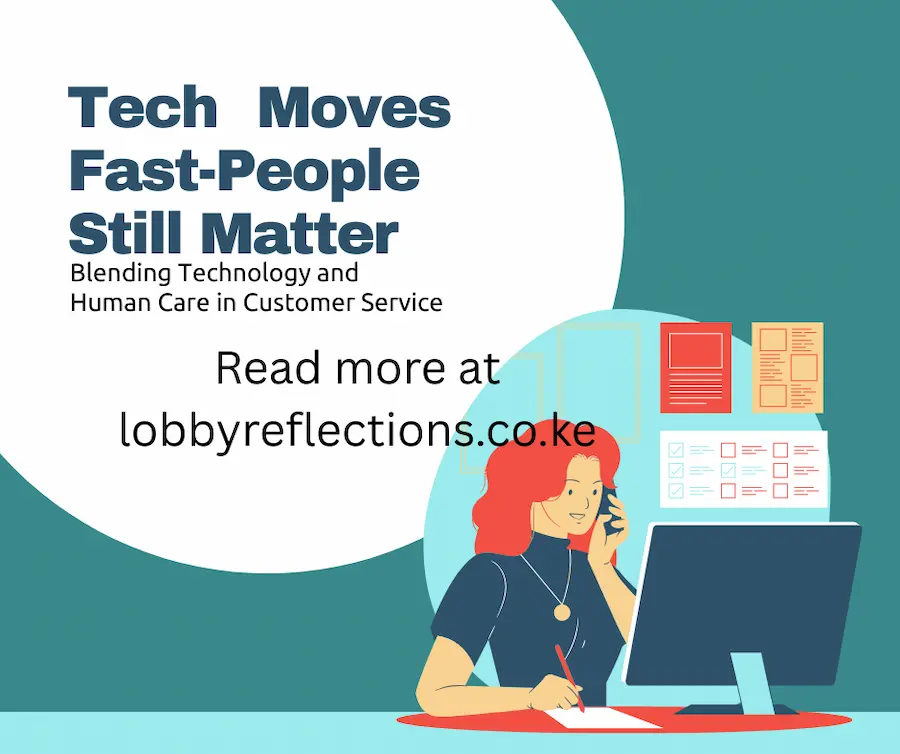
    A smiling woman offering help to a client at a desk with a computer and paperwork, symbolizing the blend of technology and human care in customer service.

    Technology Moves Fast—But People Still Matter

    In today’s world, customer service is evolving at lightning speed. Chatbots provide instant answers, mobile apps put services at our fingertips, and digital systems streamline processes like never before. Artificial intelligence (AI), machine learning, CRM platforms, biometric verification, and self-service kiosks are transforming how we engage with customers.

    These innovations aren’t just convenient—they’re essential. They bring efficiency, scalability, and accessibility we couldn’t have imagined a decade ago. From banking apps to healthcare portals and government e-services, digitization has revolutionized how we connect. And yet, amid all this progress, one element remains irreplaceable: human compassion.


    Blending Technology and Human Care: A Front Row Seat to Humanity

    As someone who has worked in multiple customer-facing roles—from private clinics to church offices and even behind a security desk—I’ve had the privilege of witnessing countless moments that digital systems simply can’t replicate.

    Every day, I sit at a desk that offers a front-row seat to the human experience. My role goes far beyond issuing forms or verifying documents; it’s about meeting people at their most vulnerable. No system upgrade can replace empathy, patience, or kindness.

    I’ve worked in environments where the Wi-Fi goes down but the human connection stays strong. And I’ve realized that technology can enable better service—but only when the human heart remains engaged.


    Where Blending Technology and Human Care Meets Real-Life Struggles

    Technology has solved many service bottlenecks, but it hasn’t erased human challenges:

    • Pregnant women walk in, carrying not just babies but emotional and financial burdens—despite having booked appointments online.
    • Elderly clients struggle with digital platforms, even as voice-activated or biometric systems claim to be more inclusive.
    • People with disabilities remind us that even the most “accessible” systems need human backup.
    • Those who can’t read or write are excluded by text-heavy apps and SMS-based services.
    • Even tech-savvy customers still need reassurance, clarity, and sometimes just a friendly face.

    These stories don’t show up in chatbot logs—but they define what blending technology and human care should look like.


    Bridging the Gap: Blending Technology and Human Care Through Compassion

    Digital transformation should never erase the human touch—it should enhance it.

    Here’s what that looks like in practice:

    • A chatbot answers FAQs—but a human follows up with personalized support.
    • An app books the appointment—but a receptionist senses stress and provides reassurance.
    • AI flags errors—but a patient agent helps correct them with empathy.
    • A CRM system reminds a customer care agent of a previous issue—but only the agent knows the right words to soothe a client who’s had a bad day.

    Technology offers speed and precision. People offer warmth and understanding.

    • A screen can’t smile back at a tired mother.
    • An automated message can’t gently help an elderly client fill a form.
    • A kiosk can’t notice if someone is too weak to stand.

    But we can.

    This is the core of what I’ve learned from years in customer care. Tools matter—but people matter more.


    Real-Life Insight on Blending Technology and Human Care

    In a related post, Customer Service in Microfinance: What I Learned on the Job, I reflected on my time in a high-pressure microfinance role. There, technology helped us process clients faster—but it was compassion that earned trust. From elderly clients trying to grasp loan terms to single mothers panicking about deadlines, blending technology and human care made all the difference.


    Tools That Support Blending Technology and Human Care

    Technology, when used wisely, frees up time to allow humans to be more present. Here are a few affordable tools that enhance—not replace—human-centered customer service:

    🖥️ Adjustable Laptop Stands (Affiliate link)

    These not only improve posture but make it easier for receptionists and desk agents to stay comfortable and focused—especially during long hours.

    📷 Webcams with Built-in Mics (Affiliate link)

    For virtual customer care agents or online consultants, these help maintain eye contact and clear communication—critical for trust-building.

    🖇️ Form-Filling Clipboards with Storage (Affiliate link)

    A lifesaver for field staff or hospital desks—keeping paperwork organized while showing clients you’re prepared.


    📚 Need More Affordable Office Tools?

    Don’t miss: Affordable Office Essentials for Remote Workers
    This blog post breaks down budget-friendly tools that help professionals combine tech efficiency with a human-centered approach.


    Stories That Show Why Blending Technology and Human Care Works

    Some experiences in customer care never fade. These moments, for me, define why the human element must never be lost:

    • The woman who had no one left, but still smiled as I helped her process her medical form. Her resilience humbled me.
    • The grandmother raising her grandchildren alone, who was simply grateful someone explained her NHIF(SHA) deductions kindly.
    • The blind men who didn’t ask for charity—but simply needed help with paperwork and were delighted when I took the time.

    These moments remind me that customer service is never just about what we do—it’s about how we make people feel.


    Why Emotional Intelligence is Crucial When Blending Technology and Human Care

    A recent Forbes article highlights how emotional intelligence is more important than ever in the age of AI, especially for customer-facing roles. It explains that while AI can automate repetitive tasks, it cannot replicate human qualities like empathy, active listening, and relationship-building time.com+15forbes.com+15forbes.com+15.

    Investing in emotional intelligence training isn’t just a “nice-to-have”—it’s essential. It ensures that tech tools support human connection rather than replace it.


    The Future of Customer Care: Blending Technology and Human Care for Good

    AI-driven sentiment analysis, facial recognition, and CRM tools will continue to advance. But for these tools to serve—not override—the human connection, we must invest in:

    • Emotional intelligence
    • Active listening
    • Inclusive communication
    • Patience and kindness
    • Real-life human support channels

    Because the future isn’t just high tech—it’s high touch.

    A service team equipped with both technological tools and heart-centered skills is unstoppable. That’s how we build customer loyalty, not just customer numbers.


    More Than a Transaction: The Legacy of Blending Technology and Human Care

    Whether we work in a bank, clinic, government office, or online help desk, we must not forget: behind every login ID, service ticket, or chatbot interaction is a person.

    And when compassion meets customer care, we don’t just solve problems—we touch lives.


    What’s Your Take?

    Have you ever had a service experience where the human touch made all the difference?

    Or maybe a moment when technology failed, and a kind person stepped in?

    Let’s keep this conversation going. Share your story in the comments or connect with me on LinkedIn. I’d love to hear your perspective.

    Together, let’s build a future where blending technology and human care is the standard—not the exception.


    📌 Support This Blog

    Love reading honest, real-life reflections from behind the desk? Support Lobby Reflections by checking out these useful picks on Amazon:

  • Power of Consistency: Finding Purpose in Routine

    An elderly African man wearing a blue cap and jacket pushes a bicycle with a large milk can along a rural road at sunrise, symbolizing consistency and resilience.

    Power of Consistency: Finding Purpose in Routine

    Every morning, I walk 4 kilometers to work. At first, it was tough—lungs burning, legs sore, unsure if I’d make it. But I stuck with it. Step by step, I discovered the power of consistency. Not just physical results like weight loss and strength, but a deeper sense of purpose.

    This routine became more than a commute. After childbirth and recovery, it helped me reclaim myself—emotionally and mentally. I realized that when you show up daily, even in silence, you’re building something bigger than just a habit. You’re building a life.

    A : Power of consistency

    This walk wasn’t just about getting to work anymore. Coming out of the vulnerable post-birth season, it felt like I was reclaiming myself. The road became a place of reflection, renewal, and peace. The power of consistency taught me that growth doesn’t come from one grand act—it’s the everyday effort that shapes us.

    💬 “Consistency is more important than intensity.” — James Clear, author of Atomic Habits

    And it’s true. Walking every day helped me believe in my own strength again.

    As I continued this routine, I discovered something more valuable than just fitness. I discovered the power of consistency — the quiet strength that builds resilience, purpose, and even joy in the small, daily steps.

    As author James Clear explains in this insightful article on consistency, small repeated actions often lead to the biggest results over time.


    The Milkman Who Walks with Purpose

    Then I noticed the milkman.

    An elderly African man, probably in his sixties, pushing a bicycle with a 100-litre milk tin. He wore the same blue coat and cap each day. Whether the sun blazed or the rain poured, he showed up — always pushing forward.

    The first time I saw him, I felt sorry. This must be too much for someone his age, I thought. But day after day, there he was. That’s when I realized: this wasn’t about pity. This was about purpose. He was living the power of consistency, not just to earn a living, but to preserve his dignity.


    Meeting Him Face to Face

    Months passed, and one day, he walked into my office. I work as a security guard at a government health insurance parastatal. He had come to follow up on SACCO contributions that weren’t reflecting in his NHIF (now SHA) account.

    I watched him go back and forth—calm, steady, patient. Eventually, our officer called the SACCO and sorted it out. That day, I finally asked him, “How do you do it? Walk every day with that heavy bicycle?”

    He looked at me and said,

    “I don’t want to be anybody’s liability. As long as I can move each day, I got to go.”

    That sentence has never left me. It embodied the power of consistency in such a quiet, strong way.


    Recommended Gear for Daily Walkers

    If you’re trying to build your own walking routine, comfort is everything. These items help me stay consistent and injury-free:

    🥿 Supportive Walking Shoes
    Comfortable and light, perfect for daily 4km walks.

    🧦 Anti-Blister Socks
    Protect your feet and keep moisture away.

    🌧️ Reflective Rain Jacket
    Essential for those rainy or early morning commutes.

    Affiliate disclosure: I may earn a commission if you buy through the above links—at no extra cost to you.


    More Than Just a Commute

    Both the milkman and I walk every day, for different reasons. But what unites us is that consistency has given us strength. It’s not glamorous. No one claps for you at 6:30 AM in muddy shoes. But this daily rhythm builds character, stamina, and mental resilience.

    In a world obsessed with instant results, the power of consistency is a quiet rebellion. A choice to grow slowly, purposefully, with faith in the outcome.


    From the Road to the Office: Consistency in Customer Care

    Consistency is not just for walking — it matters in every role we play. In my customer service job, I’ve seen how steady patience can defuse even the most difficult client situations.

    If you’ve ever wondered what customer care looks like behind the desk, check out this honest piece:
    👉 Handling Unstable Customers in Customer Care Kenya

    We often underestimate how much power there is in simply showing up. Every day.

    #PowerOfConsistency #DailyRoutineMatters #InspirationFromEverydayLife #WalkingToWork #CustomerCareChronicles #AtomicHabitsInAction

  • Customer Care in Microfinance: What I Learned on the Job

    Just after college, I found myself in that familiar post-graduation limbo—unemployed, uncertain, and searching for direction. When a friend recommended a casual data entry job at a local microfinance institution, I grabbed the opportunity. That role, though simple on paper, became my unexpected entry point into the world of customer care in microfinance—a world where numbers met real lives, and where empathy and listening would become more important than spreadsheets.

    But it didn’t take long before I realized I wasn’t just working with numbers—I was supporting livelihoods. My exposure to customer service in microfinance came not from a training manual but from the lived reality of small business owners, group borrowers, and struggling families who relied on us. And soon, I would be forced out from behind the screen and into a world of real human connection.

    If you’re not familiar with microfinance, it refers to small-scale financial services provided to low-income individuals or groups who lack access to traditional banking. You can read more about it on Wikipedia’s Microfinance page or through organizations like FSD Kenya and VisionFund International, which support financial inclusion initiatives in Africa.


    "Wambui working at a microfinance branch office in Kenya, learning the importance of customer service in microfinance."

    Me at the branch office where I first experienced real customer service challenges in microfinance.


    Understanding Customer Service in Microfinance

    When I was transferred to a coastal branch of the institution, my work environment changed drastically. Unlike in Nairobi, clients here didn’t walk in alone—they came in groups. These were community-based lending groups, also known as chamas, a key feature in microfinance models across Kenya.

    While I still worked behind the scenes as a data clerk, I quickly learned that customer service in microfinance isn’t just a front-desk concern. Our system had a strict auto-logout at 4:00 PM. If payments weren’t keyed in before then—due to a power cut or unstable internet—the resulting backlog could prevent an entire group from qualifying for a new loan. That single late entry could impact someone’s school fees, business capital, or emergency funds.

    Accuracy and timeliness weren’t just KPIs—they were the backbone of trust.


    The Crisis That Forced Me into Frontline Customer Service

    My real baptism by fire came during a major system upgrade. The platform slowed to a crawl, queues snaked out the door, and the secretary couldn’t keep up with complaints. That’s when agitated clients began appearing at my desk—accusing me, the “IT girl,” of ruining their livelihoods.

    “Why should I suffer in my business while you delay my loan?”
    “How can I pay on time if your system can’t process payments?”

    Suddenly, I was no longer invisible. I was the face of the delay, the punching bag for client frustration—and the unlikely representative of customer service in microfinance.

    I had no formal customer care training, no script, no manager beside me. All I had was a growing sense that these people needed to be heard.


    The Art of Listening in Microfinance Customer Service

    At that moment, I stumbled upon a skill that would become my greatest asset: the art of listening.

    It didn’t matter that I had no immediate solution. People wanted someone who would listen, acknowledge their frustration, and explain what was going on with empathy—not bureaucracy.

    Listening, truly listening, defused tempers. It turned angry monologues into calm dialogues. And slowly, it built trust. This was customer service not in theory, but in practice.

    You can read more about how I learned to de-escalate tough situations in this related post:
    🔗 Handling Unstable Customers in Customer Care Roles


    What Makes Customer Service in Microfinance Different?

    Most customer-facing roles require patience. But customer service in microfinance comes with unique pressure:

    • You’re dealing with group guarantees—if one member defaults, the entire group feels it.
    • You’re servicing low-income clients whose financial ecosystems are fragile.
    • Often, you’re the only point of contact in a system many clients don’t fully understand.

    So, when a transaction goes wrong, it’s not just an inconvenience. It’s a crisis.

    That’s why empathy, speed, and clear communication are essential. Even your tone can make the difference between a client storming out or staying calm.


    From Spreadsheets to Stories: The Human Side of Microfinance

    Behind every transaction I processed was a human story. A mama mboga hoping to restock for market day. A boda boda rider needing new brake pads. A school owner preparing for next term.

    I began to understand that customer service in microfinance is about recognizing those stories. Every data entry was a thread in someone’s life.

    This experience made me see that microfinance is not just a system—it’s a support network for dreams.


    Tools That Can Improve Customer Service in Microfinance

    If you work in this sector—or aspire to—there are tools and books that can help you improve both your efficiency and empathy. These resources have helped many like me transition from reactive to proactive service:

    📘 The Customer Service Survival Kit – A practical guide for handling difficult customer moments
    🧠 Emotional Intelligence 2.0 – Improve your self-awareness and interpersonal skills
    💻 Logitech K120 Wired Keyboard – Comfortable and reliable for long data entry hours
    📅 Blue Sky Weekly Planner – Helps you plan for busy repayment days and disruptions

    Disclosure: This post contains Amazon affiliate links. If you click and buy, I may earn a small commission at no extra cost to you.


    Key Takeaways: It’s More Than a Job Description

    That job taught me that real customer service isn’t written in your contract—it’s shown in how you show up for people.

    • Systems may fail.
    • Power may go out.
    • Clients may yell.

    But your ability to stay calm, listen deeply, and explain honestly—that’s what makes the difference.

    If you’re working in microfinance or thinking about it, remember: customer service in microfinance is not a title. It’s a responsibility.


    Your Turn: Have You Been There?

    Have you ever had to manage clients without a manual or deal with emotional situations in unexpected ways?

    Let’s connect. Share your story in the comments or message me on Facebook. I’d love to hear how you’ve handled similar challenges.

  • How My Customer Care Journey Began: From Mum’s Shop to Supermarket Sales

    A Kenyan woman standing inside a small shop filled with second-hand clothes, smiling as she serves a customer — symbolizing the humble beginnings of a customer care journey.

    Before I ever stepped into an office or wore a name tag, I was already learning the art of customer care — not from a training manual, but from the small shop my mother ran by the roadside. Looking back, I realize that the most meaningful lessons in my customer care journey didn’t come from a corporate orientation or a polished supervisor. They started much closer to home — in the dusty aisles of Mum’s shop, surrounded by laughter, bargaining, and the scent of second-hand clothes.

    Those early days shaped how I see service, responsibility, and even leadership. What looked like simple daily routines were actually my first steps in the long, beautiful, and sometimes bumpy customer care journey that continues to this day.


    How My Customer Care Journey Started at Home

    As a teenager, I was still figuring out who I was — somewhere between schoolwork, friends, and chores. Whenever Mum needed to step away, she would leave me in charge of the shop. My instructions were clear: serve sodas cold, follow her pricing rules, and always return the correct change.

    What seemed like a simple duty turned out to be my first real training in customer service. Every smile from a customer, every coin counted right, and every polite “thank you” built my confidence. It felt good to serve others and to be trusted with something meaningful.

    Those moments taught me that good customer care isn’t about a title or a uniform — it’s about attitude. Whether in a small shop or a big company, how you treat people defines the experience.

    But of course, not all days were easy.


    The Day My Customer Care Journey Took a Turn

    One afternoon, council askaris appeared unannounced. At the time, it was mandatory for every business to display the president’s portrait. Ours, unfortunately, was tucked in a drawer. Before I could explain or even breathe properly, they whisked me away and took me to court.

    I was terrified. The courtroom felt cold and intimidating. A man approached and offered legal help, telling me to plead not guilty along with others. Out of fear and confusion, I agreed. The next few hours felt endless — a blur of waiting, anxiety, and tears.

    Then, like a storm breaking, Mum appeared. She was furious but also fiercely protective. Within minutes, she clarified the misunderstanding, paid a small fine, and got me released. I can still remember the mix of anger and relief in her voice when she said, “Next time, display the portrait!”

    That incident taught me more than any textbook ever could. I learned about responsibility — that being left in charge means understanding every rule, even the ones that seem small. I also realized that in business, ignorance is not an excuse. Whether it’s licenses, receipts, or compliance, small details can make or break your peace.


    Lessons That Shaped My Customer Care Journey

    That day changed how I handled every task after that. I became more cautious, more observant, and more respectful of systems. But it also deepened my empathy. I saw how easily things can spiral when someone simply doesn’t know.

    It taught me something every customer care professional should understand: people often act out of fear or confusion, not defiance. Patience, therefore, isn’t optional — it’s the foundation of great service.

    👉🏾 Related Post: Blending Technology and Human Care


    From Street Sales to Strengthening My Customer Care Journey

    Years later, after college, I found myself in a totally different setup — standing outside supermarkets, selling car tracking insurance. It wasn’t glamorous, but it was honest work. My job was to approach shoppers, explain the product, and hopefully, convince them to sign up.

    As an introvert, this was my personal mountain. Talking to strangers was hard. Rejection stung. Yet every morning, I showed up, determined to do better than yesterday. Over time, I learned how to read facial expressions, adjust my tone, and handle the word “no” without taking it personally.

    Some customers smiled and declined politely. Others dismissed me with a wave. A few listened — and even if they didn’t buy, they left with a good impression. Each interaction was a new classroom. I was unknowingly building my emotional intelligence, one conversation at a time.

    These moments reminded me that customer care isn’t confined to a desk. It’s in every word, every smile, and every effort to connect.

    👉🏾 Related Post: Customer Service in Microfinance


    Books That Strengthened My Customer Care Journey

    During this period, books became my quiet coaches. When rejection felt heavy or motivation ran low, reading recharged me.

    One book that left a deep mark was How to Make Friends That Last by Paul Richter. The lessons on listening, empathy, and connection transformed how I approached clients. I learned that being genuine is far more persuasive than using perfect words.

    Later, I discovered The Introvert’s Edge to Sales by Matthew Pollard — a game changer. It taught me that introverts don’t need to mimic extroverts to succeed in sales. Our strength lies in thoughtful conversations, attentive listening, and strategic preparation.

    📚 Check out these books on Amazon:

    And for anyone juggling side hustles, I recommend using a Small Business Daily Logbook — a simple tool for tracking sales, expenses, and goals. It keeps you consistent and accountable.

    🛒 See the Small Business Daily Logbook on Amazon

    (Affiliate disclaimer: This post contains affiliate links. If you buy through them, I may earn a small commission at no extra cost to you. Thank you for supporting Lobby Reflections.)


    The Real Meaning of Customer Care

    With every new role I took on — whether in sales, data entry, or front desk work — the same truth followed me: customer care is a mindset.

    It’s not about always being cheerful. It’s about being present. It’s about treating each person — whether angry, confused, or grateful — as human first.

    Great service is built on three things:

    1. Presence: Listening actively, not just waiting to respond.
    2. Integrity: Doing what’s right, even when no one is watching.
    3. Compassion: Remembering that people come to you because they need help.

    When you practice these, every role becomes meaningful — even the smallest one.


    Why My Customer Care Journey Still Matters Today

    From the counter of Mum’s shop to the crowded supermarket entrance, my customer care journey has been full of real-life lessons. I’ve learned that good service doesn’t require a title or a corporate badge — just a genuine heart and a willingness to grow.

    Even now, as I write for Lobby Reflections, I draw from those humble beginnings. Every story, every article, and every reflection is rooted in those early lessons — of patience, humility, and emotional intelligence.

    👉🏾 You might also enjoy: The Thankless Job of a Hero


    A Note to Small Business Owners on Building a Lasting Customer Care Journey

    If you run a small business, don’t underestimate the value of everyday interactions. Every smile counts. Every returning customer is a vote of confidence. And every challenge you face is preparing you for something bigger.

    Take time to learn your systems, document your progress, and treat your customers like partners — not just buyers. Whether you’re selling sodas, deras, or digital products, the principles remain the same.

    💡 For more tips on business growth and service improvement, check out resources from the SME Founders Association Africa or HubSpot’s Customer Experience Blog for practical guides.


    💬 Over to You

    Do you remember the first time you served someone — maybe in your parent’s shop, a summer job, or helping a neighbor?

    🌟 What was your first customer care journey moment? I’d love to hear your story. Share it in the comments or message me directly.

    Because at the end of the day, every service story matters — and every humble start has value.